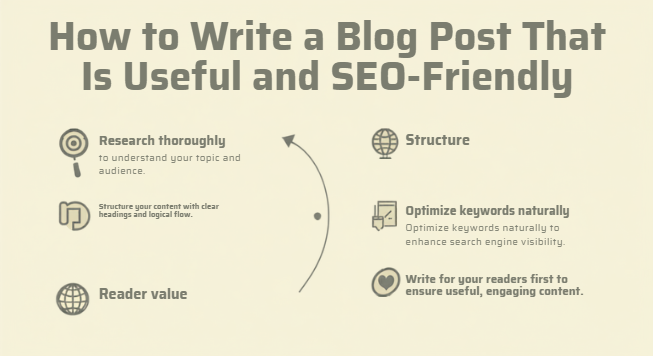
A reader once emailed me something that stuck with me longer than I expected: “This is the first article on this topic that actually answered my question instead of making me scroll through your life story first.” Slightly blunt, but fair. That email came after I’d rewritten my approach to blog posts following almost a year of publishing content that either read like a rambling diary entry or, on the opposite end, like a robotic keyword-stuffed mess I’d forced together purely to “rank.”
Finding the actual balance between genuinely useful and properly SEO-friendly took me embarrassingly long, mostly because I kept treating those two things as if they were in conflict with each other. They’re really not. The posts that ended up ranking best on Google were, without exception, the same ones readers actually found helpful. Once that clicked for me, writing got both easier and more effective at the same time.
Why I Used to Get This Completely Backwards
My early approach was almost comically split into two bad extremes. Some posts I wrote purely for myself, meandering, personal, genuinely enjoyable to write but with zero structure a search engine (or a busy reader, honestly) could make sense of. Other posts I wrote purely “for SEO,” repeating my target keyword awkwardly every few sentences, structured entirely around what I thought Google wanted rather than what a real person needed.
Neither approach worked. The diary-style posts never got found. The keyword-stuffed posts got found occasionally, but readers bounced almost immediately because the content wasn’t actually useful once they arrived.
Step 1: Start With a Real Question, Not a Topic
This shift changed everything for me. Instead of thinking “I want to write about budget laptops,” I started framing posts around actual questions: “Which budget laptop can handle basic coding software?” That’s genuinely how people search, and building the post directly around answering that specific question kept it focused in a way vague topic-based writing never did.
I usually check Google’s “People also ask” section and related search suggestions before writing anything now, just to see the actual phrasing people use, rather than guessing.
Step 2: Write a Title That’s Honest and Specific
My early titles were either too vague (“My Thoughts on Budget Tech”) or, in a later overcorrection, way too keyword-crammed (“Best Budget Laptop Cheap Affordable Laptop For Students 2023 Buying Guide”). Neither read naturally, and neither performed well.
What actually works is somewhere in between — clear, specific, and readable as an actual sentence a human would say. “Best Budget Laptops for Coding Students in 2024” tells you exactly what you’re getting, includes the natural search phrase, and doesn’t sound like it was generated by cramming keywords together.
Step 3: Answer the Core Question Early, Not After Three Paragraphs of Backstory
This is exactly what that reader’s email was pointing out. My earlier posts often buried the actual useful answer several paragraphs deep, after unnecessary introductions about my personal history with the topic. Readers (and honestly, Google too, to some extent) reward content that gets to the point efficiently.
Now I try to give a genuinely useful answer within the first couple hundred words, saving the deeper detail, examples, and nuance for the sections that follow. People can always keep reading for more depth, but they shouldn’t have to hunt for the basic answer.
Step 4: Structure With Headers That Actually Help Navigation
I used to write long, unbroken walls of text, assuming headers were just an SEO formality. Once I started actually using clear H2 and H3 headers that reflect real subtopics or subquestions, two things happened — readers could scan and jump to what they needed, and my content became noticeably easier for search engines to understand and categorize properly.
A good test I use now: could someone skim just the headers alone and get a reasonably accurate sense of what the whole article covers? If not, the structure probably needs work.
Step 5: Write Naturally, Then Check for SEO Elements After
This order matters more than I initially realized. Writing with SEO in mind from the very first sentence tends to produce stiff, unnatural-sounding content. What works better for me now is writing the post genuinely, the way I’d actually explain it to a friend, and then going back afterward to check things like:
- Does my target keyword appear naturally in the title, first paragraph, and maybe one or two headers, without feeling forced?
- Is there a clear, accurate meta description summarizing the post?
- Are there natural opportunities for internal links to other relevant posts on my site?
- Does the URL slug make sense and reflect the actual topic?
Doing this as a review pass instead of a writing constraint kept my content sounding like an actual person wrote it, which, unsurprisingly, is also generally what performs better long-term.
Step 6: Include Real Examples, Not Just General Advice
Generic advice posts blend together online — there’s an overwhelming amount of surface-level content repeating the same vague points. What actually differentiated my better-performing posts was including specific examples, real numbers, or genuine personal experience rather than just restating common knowledge everyone already has access to elsewhere.
My laptop comparison post specifically named models, current prices at the time, and explained exactly why certain specs mattered for coding software specifically, rather than vaguely saying “look for a laptop with good specs,” which tells a reader almost nothing actionable.
Step 7: Keep Paragraphs and Sentences Digestible
This sounds like a small detail, but it genuinely affects both readability and how long people actually stay on the page. My early writing style involved long, winding sentences that were exhausting to read on a phone screen, which is how most people are actually reading blog content these days. Shorter paragraphs, varied sentence length, and the occasional short standalone sentence for emphasis make content significantly easier to actually consume.
A Real Before-and-After Example
My original earbuds article (a recurring example in my own mistakes, admittedly) opened with three paragraphs about my general relationship with audio products before even mentioning a single specific earbud recommendation. It ranked nowhere and had a bounce rate close to 90%, based on what I could see in my analytics.
When I later rewrote a similar comparison-style post about laptops, I opened with a direct answer to the core question within the first 100 words, used clear headers for each recommendation, and included specific real details throughout. That post’s bounce rate sat closer to 45%, and it’s remained one of my consistently best-performing pieces of content since.
Common Mistakes to Avoid
Burying the actual answer under unnecessary introduction. Readers (and search engines) both reward getting to the point efficiently.
Keyword stuffing instead of writing naturally. It reads poorly to humans and generally doesn’t help rankings the way people assume it still does.
Writing overly generic advice without specific examples. Vague content blends into the enormous amount of similar content already online.
Ignoring structure entirely. A wall of unbroken text, even if genuinely useful, is harder for readers to actually use and for search engines to interpret clearly.
Treating SEO and usefulness as separate goals. In my experience, they’re almost always the same goal wearing different framing.
Skipping the editing pass for basic SEO elements. Writing naturally first is good, but skipping the follow-up check on title, meta description, and structure leaves easy improvements on the table.
Final Thoughts
The posts that actually work aren’t the ones optimized purely for search engines, and they’re not the ones written purely as personal expression either — they’re the ones that genuinely respect a reader’s time by answering their actual question clearly, while naturally including the structural elements that help the right people actually find that content in the first place.
That blunt reader email ended up being one of the more useful pieces of feedback I’ve gotten, even if it stung a little reading it. Write like you’re explaining something clearly to one specific person who actually needs the answer, structure it so both that person and a search engine can easily follow along, and the SEO side of things tends to fall into place far more naturally than chasing it directly ever did for me.